Showing posts with label Cambodian ethnic minorities. Show all posts

Thursday, August 30, 2012

Fears for ethnic radio’s future

Rorchom Saroeun, a 20-year-old ethnic Jarai radio announcer, broadcasts during a program for ethnic minority communities on FM 95.5 in Ratanakkiri province. Photograph: Heng Chivoan/Phnom Penh Post

Thursday, 30 August 2012
May Titthara
The Phnom Penh Post

‘Mae Mang Kit Sith Ngay Panes Laek Ra Kornong Pades Krae” in the mother tongue of the ethnic Tumpoun minority translates to “global human rights affairs”, which is exactly what the Voice of Ethnic Minority Communities radio program has been bringing to the most isolated ethnic communities in Ratanakkiri since 2007.

The radio program broadcasts in four languages – Jarai, Tumpoun, Kreung and Prao – for two hours, five days a week, and program president Eoun Som Ath said there was increasing demand for more air time.

“If possible, I want to add more broadcasting hours, because it is a significant program for the ethnic minorities to learn about health issues, agricultural methods and their own traditions,” he said.

Wednesday, September 07, 2011

In Ratanakkiri Land Dispute, Long Wait for a Judge

An elderly couple, one of the minority villagers, living in Ratanakirri, are also caught up in a land dispute with the sister of Cambodia’s Finance Minister, Keat Chhon. (Photo: by Say Mony)

http://www.youtube.com/watch?v=8i-OVzv7vZo&feature=player_embedded

Tuesday, 06 September 2011
Say Mony, VOA Khmer | Ratanakkiri province, Cambodia
“We used to cultivate, herd cattle, look for animals and vegetables, like bamboo shoots, and harvest rice there, but now it has been cleared."
Minority villagers who are caught up in a land dispute with the sister of Cambodia’s Finance Minister say they have waited years for the courts to look at their complaints. But in this remote part of the country, they say, they have had little luck getting a judge willing to take on the case.

The land dispute is centered around Kong Yu village in Ratanakkiri province. Villagers here say they have waited four years to have a hearing for their complaints against Keat Kolney, the sister of Keat Chhon, who is the Finance Minister and holds the position of Deputy Prime Minister.

They made their complaint in January 2007, claiming they had been tricked out of their ancestral land for a rubber plantation backed by Keat Kolney.

The land grabber is a big person,” said Lmam Phil, a representative of the villagers, who belong to the Jarai minority. “But the judge is a small one, as the villagers and myself understand it.” That means no judge will touch the case, for fear of retribution, he said.

Wednesday, August 24, 2011

Support Oxfam to prevent Cambodian land grabs

August 23, 2011
Seacoastonline.com

To the Editor:

Chanthy Dam runs an organization in Cambodia called the Highlander Association, which helps indigenous communities like La Lai protect their rights from mining and logging concessions that aim to take away communal lands without consent. Civil society organizations in Cambodia report to Oxfam that there are 67 mining concessions comprising more than 3 million acres of land operating in four northeastern provinces where the highest concentrations of indigenous people live.

The Highlander Association leads training programs for village elders and activists so they can learn about their rights under Cambodia’ land laws.

“The law says no authority can take away ancestral land from an indigenous community,” Chanthy says. “Only indigenous communities have the right to manage indigenous lands.”

Unfortunately, the Cambodian government is too willing to allow logging and mining companies and large-scale plantations to take over tracts of land set aside by law for indigenous communities. That leaves people in La Lai and elsewhere with no place to go. But instead of falling back on a pattern of disengagement from the government and its policies, native communities in the highlands of Cambodia are listening to Chanthy Dam and looking at other options: negotiating, defending their rights and staying put.

Son Chhay asks govt to end companies’ land-grabbing against minority

Summary: SRP MP Son Chhay asked the govt to stop private companies from grabbing land owned by Cambodian ethnic minorities, he also asked for an end to land concessions and the return of these lands to the govt.

The companies involved in the land-grabbing are: Heng Development, Heng Brother, Hun Veasna Investment, Chang Ly and Try Pheap.

Pav Homphan, the Ratanakiri [CPP] provincial governor, rejected Son Chhay’s claim and he said that the companies do not violate the villagers’ land.

Adhoc provincial officials said that land concession granted by the govt affect rice fields and farmlands belonging to villagers because govt officials close their eyes to the violations.

Pen Bonna of Adhoc added: “If they [villagers] were not affected, they will not protest. We have seen that in all land concessions, there were protests.”

Dy Chivoandara, a representative of the violating Try Pheap companies, denied these violations.

Navuth of Veasna Investment denied his company’s violations but said that after the lands were transferred to a Viet company, the latter could have perpetrated the violations.


http://www.box.net/shared/hj29c7b2k4necylr255v

Tuesday, August 09, 2011

What does it take to help ethnic Cambodian minority in Ratanakiri?

Ask SRP councilor Seng Mardi: Getting half wet is just part of the job to help Cambodian ethnic minority people in Ratanakiri who are evicted from their lands to make way for Vietnamese companies (Photo: Son Chhay)

Monday, March 07, 2011

Land dispute prompts civil case solution

Monday, 07 March 2011
Tep Nimol
The Phnom Penh Post

Ratanakkiri provincial court issued a summons for three ethnic Tumpoun minority residents of Bakeo district’s Paor village, to appear at a hearing related to a private company’s accusations that they had illegally seized 100 hectares of their land.

The summons was sent on Wednesday to Long Lorn, a lawyer for local rights group Adhoc, which represents the codefendants Rorch Phoen, Horn Ror and Kvas Ti, requesting their presence in a civil case in provincial court on March 22, which Long Lorn confirmed they would attend.

“We will prepare some documents and witnesses to explain [our position] in court,” he said.

Friday, December 24, 2010

The view from outside the city

Thursday, 23 December 2010
Neang Sokchea & Kounila Keo
The Phnom Penh Post

Ever since urban centres were formed in Cambodia, usually around centres of trade and industrythere has been an understanding gap between people living in the rural areas and people who became accustomed to life in the city.

Ethnic groups tended to stay in the rural areas, and because they have been separated from places like Phnom Penh, they are seen, and often see themselves as foreigners in their own country when they come to the capital city.

In order to facilitate a greater sense of understanding and community between rural and urban populations, Khmer Community Development, officially established in 2005, invited 750 youth from 7 minority groups in Cambodia to join each other for a weekend of dialogue, activities and developing relationships.

Ngach Pheaktra, a tenth grader from Mondulkiri province, took part in the camping activity and said that, because this was his first trip to Phnom Penh, he sometimes felt like an outsider.


“I feel strange walking along the buildings and houses here. They are all made of brick, while our houses back in our villages are made of wood,” he said, adding that his home doesn’t have too many mosquitoes and he rarely goes on difficult journeys, but his homeland does have mountains, trees and wild animals.

Ngach Pheaktra says Phnom Penh seems much more dangerous, with all of the vehicles moving around the city. “I do not feel secure at all when I am in Phnom Penh. I heard of robbery and rape,” he said. “Compared to Phnom Penh, my village is much better off and safer,” he added.

For Kham Sopheap, a 17-year-old and twelfth grader from Rattanakiri province who is part of one of the ethic minorities in the area, told Lift that she can hardly breathe in Phnom Penh, unlike here village where there are plenty of trees and therefore lots of fresh ait. As a child, she faced a discrimination from students who asked her why she even came to school when she could not speak any Khmer. By the time she was eight, however, she was able to speak Khmer well enough to converse with her classmates.

“There are some things I like about Phnom Penh and other things I don’t like,” she said. “I like it for its amusement parks and the Royal Palace, but I certainly do not like when Phnom Penh is too crowded.”

Lat Bunart, an eleventh grader from Ratanakiri, said that she feels like Phnom Penh is a place only for wealthy people, whereas her village doesn’t require people to be rich. “People in my village are so friendly and welcome the poor and the rich, but people here seem so busy with their businesses and work,” she said. “In our village we spend the day farming and have much more free time to enjoy life.”

Wednesday, June 16, 2010

CCHR's Public Forum on Human Rights and Development for indigenous communities affected by illegal land grabbing

CAMBODIAN CENTER FOR HUMAN RIGHTS

MEDIA ALERT
For immediate release – Rattanakiri, June 16, 2010


Public Forum on Human Rights and Development for indigenous communities affected by illegal land grabbing

Since 2004 around 600 families from indigenous communities have been affected by illegal land grabbing and government granted land concessions totaling over 25 000 hectors in Rattanakiri Province. Many have been forced evicted from their land and their homes, resulting in the deterioration of their traditional way of life and culture. The indigenous communities remain in conflict with the government and private companies stealing their land and are seeking peaceful resolutions.

On the 17 June 2010 the indigenous communities, including representatives from the Charaiy, Phnorng and Tum Poun people, will have an opportunity to raise their concerns directly with parliamentarians, local authorities, civil societies, community members, and other stakeholders at a Public Forum on “Human Rights and Development” in Rattanatikiri Province. The Public Forum will consider the issues and disputes faced by the local indigenous communities relating to economic land concessions, and illegal land grabbing as they press for peaceful resolutions to the conflicts.

Kuch Moly, Funcinpec Party; Yem Punhrith, Human Rights Party; Long Ry, Sam Rainsy Party – all parliamentarians - together with Sok Hom, Provincial Council, and Ban Bunna from Adhoc have confirmed attendance at the Public Forum. Around 300 people from the indigenous communities are expected to attend.

The Public Forum will take place on June 17, 2010, from 8.a.m. to 11.30 a.m. at Adhoc’s office in village III, Sangkat Laban Siek, Banlung City, Rattanakiri Province.

For further information, please contact :

Chhim Savuth
Project Coordinator, CCHR
Tel: +855 (12) 89 98 58
email: savuth@cchrcambodia.org

Sunday, June 06, 2010

Minorities Face Continued Conflict with Plantations

Pich Samnang, VOA Khmer
Ratanakkiri, Cambodia Friday, 04 June 2010

“The target of the people is to expand their farms to meet the need of their increasing family members, so it will affect the forest as well. The forest has many enemies.”
Pheng Krong worked one day sawing at a piece of wood for construction of a new house. The 37-year-old farmer of the Brov ethnic group had plans to replace his small wooden house in Ta Gnach village, in Ratanakkiri’s Ta Veng district. What he did not have plans to do, however, is work on a patch of farmland 2 kilometers down the road.

That’s because that land has been overtaken by a rubber plantation concession.

I no longer develop on my land because I feel I can’t live here longer,” he told VOA Khmer recently. “The villagers here do not care about planting or farming on their land any more because it will be a waste of time.”

Pheng Krong and other members of 36 Brov families say they will have to clear more forest land to begin farming again. And they are not alone.

The problem of land loss is not limited to Pheng Krong’s village, but it has spread to other villages here in the province. Residents here say they are increasingly loosing long-term farmland to concessions for plantations of rubber and cashew. Thousands of families in this province depend on that land for the livelihoods. But more and more companies are establishing themselves on that land.

Romam Ting, a representative of 41 Jarai ethnic minorities in Ang Daung Meas district, 40 kilometers from Ta Gnach, said villagers are losing out to concessions.

“When companies come, they said they have concessions from the government to grow rubber trees, they have to clear the land,” he said. “When they start clearing the land, they clear our communal land that we’ve used for planting. When we protest, they say the state has granted them the land, so it’s theirs.”

That’s a potential problem for a province with 150,000 residents, mostly populated by minority tribes Phnong, Jarai, Kachork, Brov, Tavet, Kreung, Long Tumpuon. The hill tribes believe in spirits that dwell in the forests and mountains, and their lives revolve around mixed farming, fishing and the forest.

Dam Chanthy, director of the Highlander’s Association, which helps raise awareness of indigenous people on land rights issues here, said agro-industrial plantations have overlapped the forests and communal land indigenous people traditionally use to earn a living.

“Companies just work on the land without consultation with the affected communities, so the people are now facing a big threat as they need more land for their community farms,” she said in a phone interview.

At least 14 companies have applied for land concessions in the northeastern province, but only one of them has been registered as a contracted and validated company. But, the villagers say more companies are operational, and most of them overlap community land.

“Some companies do plant some young rubber trees, but they take no care of them,” one hill tribe member who asked not to be named said. “They just cut down the trees in the forest and take away valuable timber.”

The concession practice is having a big impact on the forest here.

Around 8,000 square kilometers of land in the province is covered by forest, but tens of thousands of hectares have been deforested, local environmental organizations say.

And that’s only the beginning. Eighty-five companies have been granted land concessions for more than 950,000 hectares in 16 provinces, according to government figures.

The UN’s office for human rights in Cambodia said in 2007 the concessions are having a devastating impact on the indigenous communities. More than 50,000 hectares in Ratnakkiri alone have been given over to concessions, according to the UN.

And when people lose their land, they are pushed farther into the forest, said Pen Bunna, a rights coordinator for Adhoc. The government needs to implement the existing forestry law and concession laws in order to protect the indigenous communities, he said.

Officials say they understand the problem and are working to solve it.

Pao Ham Phan, the provincial governor, said authorities have prevented land clearance on sacred forests and community farms.

“When there are overlaps with the community land, we cut away that plot of land from the concession,” he recently told reporters in his office. “Where the forests are still in good condition, we don’t grant concession rights to the companies and we also ask the companies to protect them,” he said.

Some concession requests for 10,000 hectares are reduced to 4,000 to 6,000 hectares, he said. “This shows that the government has taken care of forest sustainability.”

Meanwhile, other problems stem from villager expansions of farmland by clearing more forest.

“The target of the people is to expand their farms to meet the need of their increasing family members, so it will affect the forest as well,” he said. “The forest has many enemies.”

Thursday, May 13, 2010

The Era of “Live and Let’s Live” in Retrospect

Thursday, May 13, 2010
Op-Ed by NEAY KRUD’TH

The black and white photographs below have been taken out of a book titled “Cambodia: Land of Contrasts” by Ruth Tooze, an American Education Specialist working as US Advisor to the Cambodian Ministry of Education in 1960. The book was first published in 1962 by Viking Press, Inc. N.Y. The author was very fortunate to have found this book among a pile of thrown-away materials at the door step of a public library, and is very happy to share precious moments in time 50 years ago when most of us were still innocent children.

Many events have occurred, we witnessed powers change hands many times over, but up-close everything appears to be the same ― our nation and people are still bogged down and sunk deeper in misery, the tragic journey in circle continues. Some of these photos may evoke nostalgia as well as anger and pain, after all we are human; what makes us different from animals is that we have the capacity to reason for the greater good of humanity instead of negative thought.

A Glimpse into the Chinese Community of the Recent Past:


The wealthy elites: Students of an exclusive Chinese school in Chinatown southeast of Phsar Chas, Phnom Penh. These students generally speak very little Khmer and receive their education entirely in traditional Chinese. They were famous for their basketball and ping-pong team. Graduates of the school normally run family business or pursue higher education abroad.

A calligrapher in action making and selling “good fortune” paper banners.

Our “Instant Noodle Soup” a local version of a neighborhood “roach-coach” which is very familiar to most of us who liked Chinese noodle soup right up our alley.

Our town’s caterer: He and his crew can set up a temporary kitchen near our house and fix a very fancy feast for our wedding party and big social gathering in no time. Oh what a familiar face!

A Glimpse into the Vietnamese Community of the Recent Past:

Vietnamese children all dressed up ready for Tet big fun (Chinese/Vietnamese New Year). This neighborhood is behind the National Bank building and south of Phsar Chas where wealthy Vietnamese and Chinese families settled. There was a private Vietnamese school and a catholic church in this neighborhood. Note a French Peugeot 403, and a cyclo-pousse in the background.

“Neak Ta Youn, or Neak Ta Chen” as people called this personage on the palanquin, who while in a trance spills his own blood to make “good fortune” paper banners, which are then given to the crowd to hang on their front doors or altars so to scare away evil spirits. It was a part of the old Chinese/Vietnamese tradition during the yearly Dragon Parade in downtown Phnom Penh.

A Vietnamese folklore marching band during the Dragon Parade in Phnom Penh: The author cannot help wondering why with all the freedom enjoyed by these immigrants in Cambodia, the Vietnamese authority (past and present) are so persistent on clamping down the freedom of expression of our Khmer Kampuchea Krom in Vietnam?

A one-woman restaurant: This is where most of us spent our daily allowance going to and from school tired and hungry.

A Vietnamese fishing boat: These fishermen made their daily catch up and down the Bassac and the Mekong River. They also had a heavy presence along the river bank from Phnom Penh to Tonlé Sap. Note the net is a bit “oversized” relative to the boat.

Daily fresh catch from the country’s rivers: Fish market was generally the domain of Vietnamese women.

A Glimpse into the Cham Community of the Recent Past:

Cham fishermen: The Cham generally settled along the country’s river banks in communities congregated around mosques led by Imams. They did not usually own tracks of land nor practice farming. The majority were merchants, craftsmen and artisans. They participated in all aspects of Khmer social and professional life including serving in the armed force. Most young Chams made conscious choice to be Khmer of Cham heritage. As a minority group they were deliberately targeted and brought down to near total annihilation by the KR regime. The poorest among them were the “river nomads” as seen in the photo above. They were subsistent fishermen, living on their covered boat with the entire family and all their possession. The author personally witnessed these fishermen taking their daily prayer facing Mecca at the bow of their little boat. They traveled up and down the country’s rivers almost year round to wherever there is good catch, and sell their catch at the kampongs along the rivers. They and their family were prone to danger of boat breaking up, sinking and drowning if their small vessel get caught in big rivers’ seasonal flash flood, rising water, and swift current.

The author is compelled to look at this particular photograph with special interest and a sobering thought because of its underlying message. In the words of the author’s elders: “THI IS WHAT THE ONCE FLOURISHING CIVILIZATION OF CHAMPA HAD ULTIMATELY BEEN REDUCED INTO, IN THE HANDS OF DAI VIET”.

A Glimpse into the Khmer Leu Community of the Recent Past:


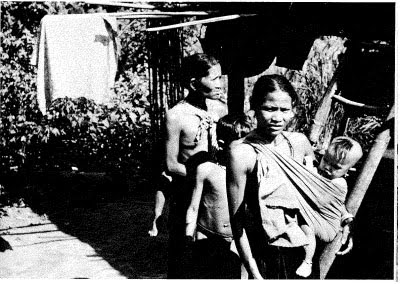
Khmer Leu Highland Tribes: The Khmer Leu tribesmen settled across the northeastern plateau along the Khmer/Vietnam border area from Kratié, to Mondulkiri, Rattanakiri, to Stung Treng. They were still very much hunters-gatherers, and to some extent taking up subsistent rice-farming, and small trades of rain forest commodities such as rare species of wood for bows, cross-bows and arrows, exotic medicinal plants, and wild animal products such as hides and ivories. Some may own elephants which they used as means of transport to travel to market towns.

Young women performing family chores: pounding rice.

A Mnong boy: Perhaps we are looking at the image of our pre-Khmer predecessors who settled this region a few centuries before the Christian era. We left them behind in the forest for bigger settlement with rice-farmlands and irrigation system, multi-season harvests, market towns and trading ports, last but not least burdensome government. Ancient Khmer Kings made it a tradition to exchange gifts and tributes with various highland and hill tribes to keep them pacified. In recent time they found themselves dodging bullets and bombs between Vietminh/NVA/VC and French/Viet/US. More recently they are being robbed and evicted from their ancestral land and habitat by Cousin Xen and his allies.

The Life of Khmer Mchas Srok in recent past:


Our People and our Rivers are inseparable!

Phnom Penh Central Market: If there were such a place called “THE MELTING POT” this place is IT. The women under the cone hats are Vietnamese, the ones under the umbrella hats are Chinese, and the one with their head wrapped in kramar or bare-headed are undeniably Khmer.

Phsar Thmey (Le Marché Central or Central Market): If the Colonial French has ever deserved any credit for giving what we truly needed it was the design and construction of this magnificent structure which stood the test of time, and served its purpose so well through our City’s ups and downs for the last ¾ of a century.

Many of us had a humble beginning from an honest-to-goodness classroom (Sala Wat) like this one. This is a bit of a gender-biased photo ― our girl classmates on the right rows ought to be in the picture frame as well. Our men teachers always looked dignified like a ship captain.

We were hardly wealthy by any standard, but we invested heavily in our wat and our Sangha. We have always preserved the tradition of our ancestors in providing and maintaining mutual duty and support between the Sangha and laity community, because we only have each other to rely on in the absence of a compassionate and dependable central government leadership.

Women co-op during rice-transplant: Without the benefit of technology and mechanical power, we combined force and took turns to work our land collectively from plowing to harvest, with the blessing of the monsoon rain. We should never forget that without the community (our village, us, the Sangha, and the wat) which has traditionally held us together for centuries, and without the bond and the unity between us we would be like “FISH OUT OF THE WATER”; our enemies are well-aware of this. That is why they have never ceased mounting flagrant assault and encroachments to isolate us and steal our land since antiquity. Note the Vietnamese cone hats were the preferred choice of head and face protection by Khmer peasants against the merciless sunray and heat.

The Outlook:

While most of the earlier immigrants came to Cambodia either to fill the voids in our country’s economic food chain, or were brought-in by the French to serve their colonial interests, or to escape war and repression in their homeland, and to find a peaceful place to raise and feed their family, the current wave of migration across our eastern border have been frightfully outside any recognizable norm ― it looks more like an invasion. We are being forced to make rooms for these new comers by a deliberate and wicked strategy of “swarming-evicting-land grabbing” contrived by a threatening neighbor with the consent of a mindless, spineless local puppet administration, under the pretext of “economic cooperation”. This sketchy and criminal act has been executed at the expense of our own citizens who hardly have been given free and fair access to opportunities which enable them to work and live with dignity. Currently most Khmers have to scrape the bottom of the barrel to secure food and basic necessities to sustain their family and themselves while the threat of eviction and land-grab are never far from real. This out-of-control, one-way, free-flow immigration policy is intensifying while the land, water, forest, and food resources are dwindling. The environmental health of the land is rapidly deteriorating with no serious and meaningful restoration effort in the work. The future outlook of our ordinary citizens is getting grimmer by the day. All things have a tipping point ― the era of “live and let’s live” may soon come to a screeching halt and begin to kick into reverse-gear rather violently.

To the Powerful Ruling Elites:

We, Khmer Mchas Srok, who have inherited and worked this land to finance, build, and defend the once an Empire, and now a tiny Kingdom, with our own blood, sweat, and tears, are asking you to examine closely the bas-reliefs along the gallery walls of Angkor Wat and Angkor Thom. Pay particular attention to the magnificent war elephants which carried kings and generals across enemy line to secure victories for the people and the land ― we are those elephants which you are riding on today. If you are so hell-bent on riding us to the ground until we are done taken our last fateful step, and collapsed under your abusive “ridership”, there will be a dire consequence ― YOU WILL BITE THE DUST!

If you anticipate your bloody allies would give you a free ride just like we did, you are only fooling yourselves….
……… HEAR OUR VOICES!

Thursday, January 21, 2010

A 5,000-year-old language in Cambodia on extinction list

January 21, 2010
ABC Radio Australia

The United Nations cultural organisation UNESCO says one language becomes extinct every fortnight. By the end of this century, the world will likely lose half of its 6,700 languages. Cambodia has 19 languages listed as endangered, and it is unlikely that many of them will survive the next 90 years.

Presenter: Robert Carmichael
Speakers: Dr Jean-Michel Filippi, linguist; Mr Noi, S'aoch villager; Blaise Kilian, UNESCO; Ron Watt, CARE International


CAMBODIAN VILLAGER: (S'aoch)

CARMICHAEL: You might have guessed that those words are the numbers from one to ten in someone else's language - in this case, that language is known as S'aoch and it is found in one small village in southern Cambodia. The S'aoch word for ten is LOP. And that is also the total number of people who are fluent in the 5,000-year-old language. In short S'aoch is dying. Language experts reckon it has perhaps 10 years before it disappears for ever. That is because the 110 S'aoch people prefer to speak Khmer, the language of the majority of Cambodians, rather than their own tongue. Dr Jean-Michel Filippi is a linguist who speaks more than a dozen languages. Filippi is studying S'aoch and has transcribed around 4,000 S'aoch words to date. His target, once the dictionary is completed, is a grammar book. Transcribing is a laborious process - here is Filippi using the Khmer language to transcribe the S'aoch word for durian, the pungent fruit common to Southeast Asia, with Mr Noi, the village chief, and his 40-year-old son, Tuem.

FILIPPI, NOI AND TUEM: (KHMER AND S'AOCH)

CARMICHAEL: And what does that mean?

FILIPPI: Durian.

CARMICHAEL: The durian fruit.

FILIPPI: Absolutely, absolutely.

CARMICHAEL: It is painstaking stuff, and even Filippi acknowledges S'aoch has no chance of survival. So why bother?

FILIPPI: Culturally-speaking a language is a unique vision of the world. You can take two languages which may appear to be - if not similar [then] very close to each other, like French for instance and English - in fact the vision of the world which applies in the French language or the English language are totally, totally different. If language disappears, a whole vision of the world disappears as well at the same time.

CARMICHAEL: Filippi explains that the S'aoch suffered such extreme poverty that they have rejected their own language and culture in favour of Khmer, hoping things will improve.

FILIPPI: In the case of the S'aoch they apparently want to get rid of their language and their cultural institution because it is linked to their poverty, to I would say to their economic situation, which compared to the Khmers is a very poor one, and so on and so on.

CARMICHAEL: But the S'aoch people are not alone in facing language extinction. The UN cultural body UNESCO says at least 19 languages spoken in Cambodia are at risk. Blaise Kilian is UNESCO's joint programme coordinator in Phnom Penh. He says the obvious factor in the demise of any language is having too few people who are fluent.

KILIAN: But besides this you have the environment. You have the way people themselves - especially the new generation - react to the change of environment. How much they are interested in preserving and transmitting their own languages. It's a number of I would say internal and external factors which play an important role besides the number of speakers.

CARMICHAEL: Kilian says the outlook for many of Cambodia's languages is bleak. But measures are being taken to revitalise some minority languages in the country's north and north-east. One step is bilingual education for schoolchildren. CARE International, an NGO, started a bilingual school programme seven years ago - it is now used in 25 schools and last year benefited 1,900 children. Ron Watt, CARE's education adviser, says the programme has gone from strength to strength.

WATT: Bilingual education is really spreading - people are very enthusiastic about it.

CARMICHAEL: Ron Watt explains that children in the first year of school use their own language for 80 per cent of classes with the rest of instruction in Khmer. The proportion of minority language used drops over the following two years, and by the time Grade 4 begins, all instruction is in Khmer. It's not ideal, but it is better than nothing. Good though that is, the lessons from the S'aoch are instructive and worrying. Their descent into poverty started when they lost their land 30 years ago. In today's Cambodia land-grabbing is rife, particularly in the north-east where many minority peoples live. With 19 local languages endangered, it is anyone's guess as to just how many Cambodia will have lost by the end of the century. This is Robert Carmichael in Phnom Penh. (S'aoch)

Wednesday, January 13, 2010

CAMBODIA: Minority Languages Face Extinction

Ron Watt, the education adviser at Care Cambodia, holds a bilingual dictionary used in Care's school programme to revitalise minority languages. (Credit:Robert Carmichael/IPS)

By Robert Carmichael


PHNOM PENH, Jan 13, 2010 (IPS) - One of Cambodia’s oldest languages – S’aoch – appears headed for extinction in the next decade. Other languages spoken by its minority people are lining up to take the place of the 6,000-year-old language in the most endangered category.

Dr Jean-Michel Filippi, a linguist who has studied the S’aoch language for a decade, has recorded 4,000 words of S’aoch and is preparing to write a grammar for the language. But even he holds out no hope for it. That is because just 10 people in a small village in southern Cambodia speak S’aoch fluently, and none of them uses it in daily conversation.

Filippi says the imminent extinction of S’aoch means his efforts to preserve something of it are critical. "That is because a language is a unique vision of the world," he says. "It’s very specific and a very peculiar classification of reality."

According to the United Nations’ cultural body the world’s remarkable diversity of 6,700 languages is dying out at the rate of one every fortnight. By the end of this century just half will remain, the U.N. Educational, Scientific and Cultural Organisation (UNESCO) warns on its website.

The work done by linguists like Filippi to document dying languages is important for a number of reasons. Filippi says that long after it is gone, a language could have uses in diverse areas such as commerce, psychology or artificial intelligence. A case in point, he says, is Navajo, the Native American language that was used by U.S. forces in World War II in the Pacific to encrypt radio transmissions, and whose story was popularised in the film ‘Windtalkers’.

Blaise Kilian, joint programme coordinator of UNESCO in Phnom Penh, says there is inevitably more than one reason for language death. The most obvious is that too few people are fluent.

"But you also have the environment and the way people themselves – especially the new generation – react to the changing environment," says Kilian. "And how much they are interested in preserving and transmitting their own language."

Filippi says the imminent demise of S’aoch has less to do with the low numbers of people who speak it, and much more to do with the attitude of the people themselves.

"Survival depends on one thing: Does the minority want to protect and save its own culture?" he asks. In the case of the S’aoch, he adds, that desire is lacking.

That is because after the murderous Khmer Rouge regime was driven from power in Cambodia in 1979, the S’aoch people found themselves unable to return to their original village. Instead they settled in a village called Samrong Loeu near the port town of Sihanoukville in the country’s south.

But without fields to work, they faced enormous difficulties. Filippi says the impoverished S’aoch now aspire to the lifestyles enjoyed by their relatively wealthy Khmer neighbours, who have fields, motorbikes and houses. And so they have put their own language and customs behind them and adopted the language of the majority Khmer population.

"When you are put in a position of economic inferiority, you tend to reject your own culture," Filippi says. That rejection has gone so far that Filippi struggles to get the surviving S’aoch even to recall their folk tales or religious ceremonies.

The case of S’aoch is not unique to Cambodia, which UNESCO estimates has 19 endangered languages. Others in trouble include Somray and Poa, with around 300 speakers each, Samre, with 400 speakers, and So’ong, with 500 speakers.

But even minority languages with just a few hundred speakers face distinctly different outcomes. Filippi says the Somray language of south-western Cambodia is likely to survive several more decades at least even though it has just a few hundred speakers.

That is because the animist religion of the Somray requires that prayers are accurately rendered in their own language to be effective, a compelling reason for the villagers to ensure their children grow up fluent.

Some languages are much more widely spoken, such as Tampuon, P’nong, Kuong and Jarai, each of which has up to 30,000 speakers living in the country’s north and north-east. Provided their communities back the effort, the chances of language survival are much higher.

Kilian says the first step to revitalizing a language is to determine its chances of being saved, and then create an orthography – a specific writing system – for educational materials. Those materials can then be used in education programmes.

In the case of Cambodia, some of that educational work is carried out by non-government organisations such as International Cooperation Cambodia (ICC) and Care International.

ICC has produced highly regarded books in minority languages, some of which Care uses in a bilingual school programme that was started in 2003. ICC also runs adult literacy programmes and records folk tales and other cultural aspects of minority life in the country’s long-neglected north-east.

Ron Watt, Care’s education adviser, says the bilingual schools education programme now has 128 teachers using four languages and teaching in 25 schools. Last year around 1,900 children were enrolled, almost half of them girls.

"The education ministry is very keen on this and now they are replicating it, with three more schools set to open next year," he says.

Under the bilingual education system, children in Grade 1 use their own language for 80 percent of classes, with the rest of instruction undertaken in Khmer. The proportion of minority languages used drops over the following two years, and by the time Grade 4 begins, all teaching is in Khmer.

Watt admits that the programme is not perfect.

"People with a language development bent would say that this isn’t a classic language maintenance model, let alone a language development model," he says, explaining that he would prefer to see instruction in minority languages continue after Grade 3. But the current programme is "much, much better than doing nothing."

UNESCO’s Kilian says the Cambodian government seems broadly receptive to preserving cultural aspects of the country’s heritage, likely in part because of their tourism value. He points out that Cambodia is known to tourists for Angkor Wat and the Khmer Rouge, but little else. That means ensuring its cultural diversity is sensible.

But no matter what efforts are taken, Cambodia will certainly have lost some of its languages by the end of the century. For the doomed languages there is little that linguists can do other than record as much as possible of the language, folk tales and customs so that when tongues like S’aoch eventually die, something of what they represented still remains.

Tuesday, January 12, 2010

Na'vi ascendant as Cambodia's languages face extinction

Tue, 12 Jan 2010
DPA

Phnom Penh - The world's rich array of languages is shrinking, UNESCO said, with one language becoming extinct every two weeks. By the end of the century, the UN's cultural body said it expected today's 6,700 languages to be halved. With them will go untold cultural diversity. It is a bleak tale and seemingly unstoppable although not every endangered language is on UNESCO's list. One called Na'vi even has its own listing on Wikipedia, where its 23-page entry covers pronunciation and grammar to frustrate the most talented linguist.

But Na'vi, whose name will be familiar to many moviegoers, is a fiction: It was invented for James Cameron's blockbuster movie Avatar, and even the US language professor who created Na'vi cannot speak it fluently. Technically, that makes Na'vi extinct, although its inventor has high hopes it would catch on.

At the other end of the spectrum is S'aoch, an ethnic minority language spoken in southern Cambodia that experts said predates Na'vi by 6,000 years. S'aoch is at least a working language with 10 fluent speakers.

But there is no Wikipedia page for S'aoch, which is on the verge of extinction. Given that there are people who speak Klingon, a language invented for the Star Trek films, and that Avatar is now the second-highest-grossing movie in history, there is a good chance Na'vi would be spoken long after S'aoch is gone.

Jean-Michel Filippi, a linguistics professor based in Cambodia, is S'aoch's most passionate supporter, having studied the language for 10 years and transcribed more than 4,000 words, which incidentally is four times the vocabulary of the Na'vi language.

He is the first to admit S'aoch has no chance. The village of Samrong Loeu, where the last speakers live, has 110 inhabitants. Just 10 are fluent, but none uses the language. Filippi stressed the lack of speakers is not solely to blame.

"Survival depends on one thing: Does the minority want to protect and save its own culture?" he said.

In the case of S'aoch, the answer is that they do not. After the fall of the Khmer Rouge in 1979, the S'aoch-speaking people were unable to return to their original village, so they ended up in Samrong Loeu with no land and are consequently poor. They see around them Khmer-speaking people with land and relative wealth and, not surprisingly, aspire to be like them.

"When you are put in a position of economic inferiority, you tend to reject your own culture," Filippi said.

S'aoch is an ancient tongue and is related to minority tongues in India and Malaysia as well as to modern Khmer. It predates the famous temples of Angkor Wat in the country's west and is also one of 19 Cambodian languages UNESCO said are at risk of extinction.

Filippi explained why the number of speakers matters less to a language's survival than one might think. Another endangered language, Somray, which is spoken by a few hundred people in western Cambodia, stands a much better chance because the villagers need the language for prayers used in their animist religious services.

"If the prayers are pronounced badly, then they won't work, so they want their children to learn the language," he said.

Blaise Kilian, UNESCO's joint programme coordinator in Phnom Penh, said an array of factors conspire to kill languages, the most obvious being too few people fluent in the tongue.

"You also have the environment and the way people themselves, especially the new generation, react to the changing environment and how much they are interested in preserving and transmitting their own language," Kilian said.

The imminent demise of S'aoch raises the question of what can be done about Cambodia's other endangered languages. Kilian said the outlook is bleak for many.

In the case of S'aoch, the only option is to do what Filippi is doing: write down and record as much of the language as possible while its remaining speakers are alive.

Some of Cambodia's languages are more widely spoken, and steps such as broadcasting radio programmes in minority languages do help - something UNESCO and the government do in the north-eastern provinces of Ratanakkiri and Mondolkiri.

Bilingual education in schools is also important, which is what the international charity Care has done in Cambodia's north-east in conjunction with the Education Ministry. Ron Watt, Care's education adviser, said the 7-year-old programme covers almost 1,900 pupils in 25 schools and incorporates four languages.

Watt said children in first grade use their own language for 80 per cent of classes with the rest undertaken in Khmer, but the proportion of minority language used drops over the following two years and, by the time fourth grade begins, all instruction is in Khmer.

"People with a language-development bent would say this isn't a classic language maintenance model, let alone a language development model," Watt said, "but it is much, much better than nothing."

It is too early to say whether efforts such as Care's as well as adult literacy classes in minority languages run by other non-governmental organizations would succeed. But S'aoch is certainly finished, and when it slips away in the next decade, the chances are that only Filippi and a few others would even notice.

Many - perhaps most - of the other 18 endangered Cambodian languages are also doomed. With their extinction will go unique customs and cultures stretching back into Cambodia's pre-history.

Saturday, August 09, 2008

Minorities Warn Against Land Concessions

By Chiep Mony, VOA Khmer
Original report from Phnom Penh
08 August 2008


A group of ethnic minorities from Cambodia's far-flung provinces gathered in Phnom Penh Friday, urging the government to reconsider its concession policies on land where they make a living on natural resources.

Cambodia's once-remote northeast has opened up to mining and other concessions in recent years, leading to a large number of displaced minorities and conflict over land.

"Don't take the land of ethnic minorities for concession," said Tep Toem, a Kuoy ethnic minority from Preah Vihear province. "Before giving land concessions to companies, the government should talk with the people in advance, whether the land concession will affect people's livelihoods or not."

Members of Cambodia's minorities spoke following a meeting in Phnom Penh sponsored by the NGO Forum. Cambodia has an estimated 190,000 minorities, comprising 17 indigenous groups.

Members of the different groups are responsible for the management of around 4 million hectares, NGO Forum said in a statement.

UN special rights envoy Yash Ghai warned on a visit last year that land disputes in rural provinces could lead to political instability.

Officials for the Ministry of Land Management could not be reached for comment Friday.

Wednesday, June 04, 2008

Cambodian NGO Forum asks Sekong River dam developers to consider environmental effects

PHNOM PENH, June 4 (Xinhua) -- The NGO Forum in Cambodia has asked the developers of a series of large dams planned for the Sekong River Basin in southern Laos to pay close attention to their potential environmental impact as fears grow for the tens of thousands of Cambodians living alongside the river's lower stretches, local media reported Wednesday.

"We are really concerned about the potential negative effects on Cambodian people living downstream of the proposed dams," NGO Forum deputy executive director Ngy San was quoted as saying in the Mekong Times newspaper.

The dams could help power the region but it is critical that these environmental concerns are not overlooked, he added.

"We do not want to oppose the government or companies which are developing the dams," he said. "But we need to think about impacts on water quality and aquatic biodiversity ... We need the (Cambodian) government to hold talks with Laos on the matter."

According to a recent report from the Cambodian Mekong River Alliance, Laos has already constructed two hydropower dams on the river, with the Houay Ho dam capable of producing 150 megawatts, and the Xekamen dam to be complete in 2010 250 megawatts, the newspaper said.

The existing dams are believed to have seriously damaged the river's ecological wellbeing both in southern Laos and northeastern Cambodia, affecting the livelihoods of an estimated 30,000 villagers living alongside it, the vast majority of whom are from ethnic minorities, it said.

Saturday, April 05, 2008

Ministries Seek to Bridge Gaps of Justice

By Chun Sakada, VOA Khmer
Original report from Phnom Penh
04 April 2008


The poor, women and minority indigenous groups suffer from informal or non-existent systems of justice, which the government is now seeking to redress.

The Ministry of Justice and the Council for Legal and Judicial Reform are seeking ways to improve access to judicial proceedings for the groups.

UNDP recently studied four provinces: Mondolkiri, Ratanakkiri, Kampong Chhnang and Kampong Speu, to see whether establishing new courts would work.

"More than 90 percent of those interviewed in Mondolkiri and Ratanakkiri said that land disputes and domestic violence are the top problems," said Raymond Leos, a top adviser at UNDP. "The people in the two provinces have almost zero access to the courts, because they are unaware of the procedures and fear corruption."

"Cases in the two provinces are similar to the provinces of Kampong Speu and Kampong Chhnang," Leos said.

Officials hope to empower the poor and vulnerable, including women and minorities.

The result of the study have been proposed for the government's plan for development.

Meanwhile, the ministries of Interior and Justice, with help from UNDP, are beginning to build district-level "justice centers" and commune-level dispute resolution practices, the UNDP said.

"The mobile courts will benefit the poor, so they won't have to travel from remote provinces, and will reduce costs when their disputes cannot be solved at the district level," said Pov Sophy, secretary-general of the Ministry of Justice.

Officials met Thursday to discuss indigenous law, examine divorce and separation issues, and to discuss "the feasibility of a Justice of the Peace system," Sophie Baranes, UNDP deputy country director for Cambodia, said.

Nut Sa An, secretary of state for the Ministry of Interior, said the government has established justice centers, or mobile courts, in four districts of Kampong Chhnang and Kampong Speu province.

They will expand into Mondolkiri and Ratanakkiri, as well as Battambang and Siem Reap in 2008, he said.

Wednesday, September 19, 2007

Government Urged to Support Rights Declaration for Minorities

Win Thida, VOA Khmer
Original report from Phnom Penh
18 September 2007


Humanitarian organizations are pushing the Cambodian government to ratify a UN declaration on human rights that would help ensure more respect for the country's ethnic minorities.

The UN declaration, which was approved at the General Assembly last week, says in part that native minorities have the right to ownership and the use of land and resources passed down from their ancestors.

Cambodia's minorities often have different forms of land ownership that leave them open to manipulation by unscrupulous officials and businessmen.

"We appeal to the Cambodian government to support and ratify the UN declaration of the rights for the native minority groups in Cambodia," a minority woman from the Kuoy tribe in Preah Vihear province said at a news conference Wednesday.

Minorities should be included in development discussions before large projects begin, she said.