Showing posts with label Police brutality. Show all posts

Tuesday, May 22, 2012

Security forces strip, handcuff women in Kratie amid eviction

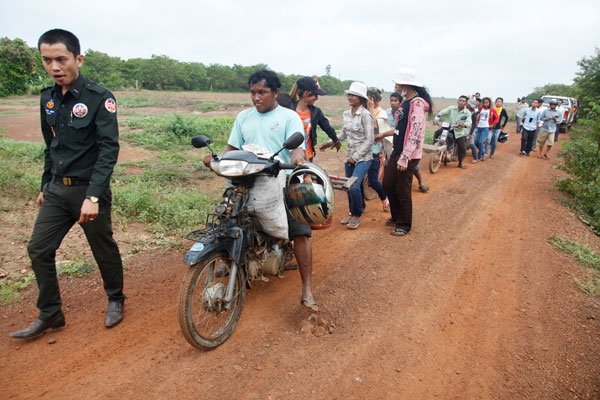
Villagers are forced to leave Pro Ma village, in Kratie province’s Chhlong district last week, during a military-led eviction which resulted in the killing of a 14-year-old girl. Photograph: Heng Chivoan/Phnom Penh Post

Tuesday, 22 May 2012
May Titthara
The Phnom Penh Post

I experienced Pol Pot’s regime, but it was not as cruel as this. Now that I’ve tasted being handcuffed and bound in the hot daylight, if I had land in another place, I would not live in the area”
Villagers detained during a bloody crackdown in Kratie province last week in which a 14-year-old was shot dead have accused security forces of brutal acts of cruelty, including forcing pregnant women to stand naked in the sun for hours.

The villagers from Pro Ma village in Chhlong district’s Kampong Damrei commune have alleged that military police and police forced men and women to strip naked, handcuffed them and left the females in broad daylight for hours while the males were not freed until the end of the day.

Almost 1,000 police and military police officers stormed the village, where residents have a longstanding land dispute with the company Casotim, at about 8:30am last Wednesday in an operation they said was to arrest the ringleaders of a group attempting to create a mini autonomous state.

Sotheavy, a 19-year-old who requested her real name be concealed, said she had “never seen such brutality” as the violence the forces employed while storming the village of about 1,000 families – which led to the death of 14-year-old Heng Chantha.

“It is so difficult to forget the event. They pointed their guns at me and ordered many women to take their shirt and underwear off, then seized our money and tied our hands behind us and ordered us to stand in broad daylight for two or three hours,” she said.

Wednesday, August 05, 2009

Hun Xen regime's police brutality against Mu Sochua's supporter

These photos were taken during Mrs. Mu Sochua's march in Phnom Penh following the announcement of her verdict (All photos: SRP)


Saturday, June 28, 2008

Tourism’s dark side: Cambodian villagers displaced in favor of development

According to the Cambodian League for the Promotion and Defense of Human Rights, police burned down 60 homes as they forcibly evicted these Cambodian villagers. (Photo: Licadho)

June 28, 2008

By Milo Anderson
Northwest Asian Weekly


The white sands of Otres Beach sit two miles south of Sihanoukville, Cambodia. It’s less crowded than the larger beaches closer to downtown. Tourists from Europe, Australia and the United States, along with Cambodians on vacation, come to enjoy the sun and the warm ocean and the small, open-air, thatched-roof bars and restaurants that line the sand. At night, Roman candles and Christmas lights reflect off the black water.

Relaxing in beach chairs facing the ocean, the tourists’ backs are turned to the red dirt road that connects them to downtown Sihanoukville, and the tiny shacks beside the road which house the evicted villagers of Spean Chhes.

On April 20, 2007, 150 soldiers and police armed with machine guns, electric batons and tear gas came to Spean Chhes, burned or demolished all the villagers’ houses, cut down their coconut and jackfruit trees and arrested several who resisted.

Of the 100 families that lived there, 80 remain by the side of the road, within sight of the concrete barrier surrounding the site of their old village and a few hundred feet from the tourists on Otres Beach. They have nowhere else to go.

The evictions in Spean Chhes are one example of a widespread problem in Cambodia. The Cambodian League for the Promotion and Defense of Human Rights (LICADHO) has documented dozens of cases of land grabbing by wealthy, well-connected individuals and companies throughout the country.

Cambodia is one of the poorest countries in the world, with a long history of violence and famine. In the past two decades it has become a major recipient of international aid money and has developed a tourism and garment industry alongside the traditional subsistence agriculture still practiced in much of the country. Economic development has raised land prices.

Manfred Hornung, a monitoring consultant with LICADHO, said it’s easy to see why Spean Chhes, located next to an attractive tourist destination, was targeted for development. “It’s prime real estate.”

According to Horm Theurn, who cleared land for a farm in Spean Chhes 15 years ago with her family, when the police and soldiers came to demolish the village they said, “It’s your fault because before when we offered you money, you didn’t take it. Now we take the land for free.”

She said she has no idea what will happen to her and the other families. She said they want to return to their land, but they are afraid they will be shot.

Villagers were also worried about their relatives in prison. Fourteen men were charged for fighting the police and soldiers with slingshots, rocks and glass bottles. One man escaped arrest, five were acquitted, one who used a machete was sentenced to four months and the remaining seven men were given the lightest sentences possible.

But when the prosecutor appealed their convictions, the men had to stay in jail awaiting their new trial. After intense lobbying by LICADHO and the UN Office of the High Commissioner for Human Rights, the appeals court finally heard the case on April 3, and the men were released a week later.

Hornung said the criminal cases against the villagers were meant to intimidate them and distract them from pursuing a civil case to get their land back, and it’s a pattern he sees in other land disputes. “The government is very successful in keeping people busy getting out of prison,” he said.

According to a 2001 land law, if someone has possessed land uncontested for five or more years before the law was passed, they have the right to claim ownership before a cadastral commission.

However, according to Hornung, no court or commission has ever addressed the issue of land ownership in Spean Chhes. And since residents were not allowed to remove their possessions before their houses were destroyed, they lost documents that may have proved how long they lived there.

“We don’t talk about the rule of law in this office,” Hornung said. “It’s just practicalities.”

The governor of Sihanoukville, Say Hak, who organized the eviction, could not be reached for comment. The information officer for Cambodia’s National Authority for Resolution of Land Disputes, Chum Bun Rong, was unable to say who resolved the question of ownership of the land, or how they reached that conclusion. He also didn’t know what the government plans to do about the villagers living by the road.

The humanitarian organization M’Lop Tapang provides basic medical assistance to the evicted villagers. Setha Thouch, a team leader with M’Lop Tapang, said the children have been hardest hit by the evictions.

During the summer rainy season, Thouch said, the ditches fill with water and many children develop skin diseases. In the dry winter months, cars, trucks and tourists riding in tuk-tuks — small three-wheel taxis — create clouds of red dust that cover everything. Respiratory diseases are common, he said.

Hornung said the unwillingness of Cambodia’s leaders to respect their own laws undercuts the mission of aid agencies.

“They knew how to make a living there,” said Hornung. “Now they are slum dwellers. This is man-made. This is not the poverty in this country.”

For more information, visit the Cambodian League for the Promotion and Defense of Human Rights at www.licadho.org. A longer version of this report is available at www.nwasianweekly.com.

Milo Anderson recently graduated from the University of Washington with a degree in journalism. The last course he took was a study-abroad program looking at social work in Cambodia. After the class was finished, he stayed in Cambodia for an additional week and wrote this report. He can be reached at info@nwasianweekly.com.

Wednesday, June 25, 2008

Kampot Housing Crackdown Continues

By Win Thida, VOA Khmer
Original report from Phnom Penh
24 June 2008


Four villagers have been arrested by military police in two districts of Kampot province and others were beaten, during operations to remove their homes from state land, rights officials and villagers said Tuesday.

The arrests follow the protest of a series of similar operations, especially in Chhouk district, where 83 families had their houses torn down earlier this month.

"The movement of the people is due to the authority that did not resolve their problems over many years, and at each election stage, the authorities promised to resolve their problems," Adhoc investigator Chan Saveth said. "But in the end, no."

"If the authorities will not settle the problem of the villagers, they might not go to vote," he added. "Because they are still concerned about their land."

Tuesday, December 18, 2007

Khmer Kampuchea Monks Chased and Assaulted by Police in Phnom Penh

CCHR-CHRAC Secretariat–CLEC-LICADHO
Media Statement, December 17, 2007

Khmer Kampuchea Monks Chased and Assaulted by Police in Phnom Penh


We, representatives of civil society, strongly condemn the excessive use of violence by the authorities against a group of Khmer Kampuchea Krom monks who gathered peacefully in front of the Vietnamese Embassy on the morning of 17 December 2007.

A group of 48 Khmer Kampuchea Krom monks, ethnic Khmer originally from Southern Vietnam, had convened peacefully in front of the Vietnamese Embassy to submit a petition calling for the release of Kampuchea Krom Buddhist monk Tim Sakhorn and five other monks imprisoned in Vietnam, the resolution of land issues, and respect for minority rights. The Ministry of Interior responded swiftly by deploying a large contingent of police and anti-riot forces who arrived armed with shields, electric batons and guns.

After the monks request for a meeting with an Embassy representative was officially rejected, they sat down at the site to conduct a traditional Buddhist ceremony. At the end of an hour-long of standoff, the monks decided to walk towards the gate of the embassy, where they were met with heavy resistance by the anti-riot police, who used their batons and shields to hit and force back the monks. Some of the monks then threw plastic bottles at the police. The anti-riot unit responded instantly, brutally charging against the monks with their shields and electric batons. The monks then scattered and tried to run away to avoid further injury.

The police continued to violently attack the monks even after they dispersed. They chased the monks four blocks down various side-streets in the area around the Vietnamese Embassy, hitting and beating the monks. Surprised passers-by were told by the police “those who we are beating are not real monks.” (In khmer: “yung wai mun men dejekhun.”)

Two monks were seriously injured after being shocked by electric batons on the backs of their heads; causing one to temporarily lose conscious. Four other monks suffered minor injuries after being assaulted by the police.

Like all citizens, monks have the right to express their opinions and gather peacefully. We appeal to the authorities to refrain from any further use of violence against monks and to ensure that the monks who gathered today will not face any recriminations from religious or state authorities. Furthermore, we request that the relevant authorities investigate and take action against officials that were responsible for assaulting the monks.

For more information, please contact,

Mr. Suon Sareth, CHRAC Executive Secretary at 092 344 357
Mr. Ou Virak, President of CCHR at 012 404 051
Ms. Naly Pilorge, Director of LICADHO at 012 803 650

Hun Sen's regime cops didn't use violence against Khmer Krom Monks ... they used savagery and brutality

A group of 48 Khmer Kampuchea Krom monks, ethnic Khmer originally from southern Vietnam, had convened in front of the Vietnamese Embassy to submit a petition (Photo: Licadho)
The Ministry of Interior deployed a large contingent of police and anti-riot forces who arrived armed with shields, electric batons and guns (Photo: Licadho)
The anti-riot unit brutally charged the Khmer Krom monks with their shields and electric batons (Photo: Licadho)
The Khmer Krom monks scattered and tried to run away to avoid further injury (Photo: Licadho)
The police continued to violently attack the monks even after they dispersed (Photo: Licadho)
Surprised passers-by were told by the police "those who we are beating are not real monks." (Photo: Licadho)
Anti-riot Police chased the monks four blocks down various side-streets in the area around the Vietnamese Embassy (Photo: Licadho)

Thursday, November 08, 2007

132 families have their houses destroyed in another Phnom Penh eviction

Two large excavators were used to demolish the villagers' homes (Photo: Licadho)

Some families were left with little after excavators broke down their former house (Photo: Licadho)

November 7, 2007
Licadho

At around 4am on November 2, 2007, more than 300 mixed police forces with two mechanical excavators - led by Russey Keo Governor Mr. Khleang Huot - came under the cover of darkness to demolish houses belonging to 132 families living in Chong Chruoy village, Chruoy Changva commune, Russey Keo district, Phnom Penh.

The mixed forces blocked access to the eviction site and prevented human rights workers as well as media from monitoring and reporting on the eviction. During the forced eviction, the authorities confiscated the camera of an observing Member of Parliament, H.E Nou Sarath from the Sam Rainsy Party and two cameras belonging to a staff member of the Housing Rights Task Force, a coalition of NGOs focusing on urban eviction issues.

In addition to the 300 mixed police forces, approximately 70 construction workers were hired by the Governor to demolish the villagers' houses. Some villagers were allowed to dismantle their houses to salvage the materials while others not and watched helplessly as their homes were destroyed. There were also allegations by the villagers that the construction workers arbitrarily looted their houses during the demolition process.

On August 30, 2007 the Russey Keo authorities had issued a notice to villagers to remove their houses within 5 days however no action was ever taken on the nominated day. The notice had stated that the purpose for the removal was "in order to eliminate disorder in the society, to protect environment, sanitation and public health, and to promote the municipality's beauty."

Relocation Conditions

Some families were left with little after excavators broke down their former houseMann Chhoeun, Deputy Governor of Phnom Penh, stated that all the villagers would be relocated to Trapeang Anh Chanh village, Trapeang Krasaing commune, Dangkor district and that they will get a plot of vacant land in the size of 4 by 10 meters. The land located on the outskirts of the city is far from amenities such as schools, markets and health care. There is no electricity, running water or waste management systems.

Trapeang Anh Chanh village is becoming one of the 'dumping' grounds for the Phnom Penh municipality to relocate poor unwanted villagers. The villagers from Russey Keo now join other land evictees from Sambok Chap village, another land eviction site in the heart of Phnom Penh which was witness to a violent and destructive eviction in June 2006. Concerns have also been raised that the villager's at the relocation site are not receiving any official documentation to guarantee that they have ownership of the land.

On November 3, 2007 LICADHO provided the 132 families with some emergency materials such as rice, canned fish and tents.

LICADHO urges the Royal Government to conduct proper relocations with adequate compensation (for legitimate land owners), shelter, water supply and sanitation for villagers. LICADHO further deplores night time evictions which contravene international law(1).

As the land eviction situation in Cambodia rapidly descends out of control LICADHO urges the authorities to respect the Cambodia's 2001 Land Law and abide by international laws and standards. Until this is fully assured, LICADHO renews its call for the Royal Cambodian Government to order a halt to all land evictions.
-------------
(1) Office of the United Nations High Commissioner for Human Rights, "Basic principles and guidelines on development-based evictions and displacement",
http://www.ohchr.org/english/issues/housing/docs/guidelines_en.pdf

Tuesday, May 22, 2007

Police Disperse Striking Workers

Chun Sakada, VOA Khmer
Original report from Phnom Penh
21/05/2007


Kandal provincial police Monday dispersed a group of striking workers who were demanding management of the River Rich Textile factory allow 10 union representatives return to work.

The workers had been on strike for several days, disrupting traffic and affecting public order, officials said.

The president of the Cambodia Alliance of Democratic Labor Union of Garment Workers, Ath Thun told, VOA Khmer more than 100 police officers dispersed about 200 workers. Several were wounded, he said.

"At about 8 o'clock, the police force and riot police were ordered to come and arrest 10 people, and one of my representatives was brutally chased in front of all my workers," he said. "There were scuffles, and some even fled to rented apartments."

Clashes lasted until noon, he said, when UN representatives arrived and settled the dispute.

"If the owner does not respect [the law] and does something bad, [the police] do not help us, but if we are on strike, they threaten us," Ath Thun said.

Police denied any injuries were incurred, but Kandal First Deputy Police Chief Sau Sothun said the strike had created anarchy that the police needed to deal with.

No one was arrested, Sau Sothun said, but three worker representatives had been summoned to the court for questioning.

Friday, May 04, 2007

Violent land eviction in Cambodia's tranquil beachside municipality

2007-05-03
LICADHO

As the construction excavator made its way towards the residents of Commune 4, police brandishing riot shields and guns marched behind it in its wake. The residents stood behind their make-shift barricades of barbed wire and household materials, steadfast in the path of the massive excavator and its entourage. This was the scene at Commune 4, Mittapheap District in Sihanoukville – a municipality best-known as a beach holiday destination – early in the morning of April 20, 2007.

Some 150 military police and police officers armed with guns, electric batons and tear gas were there to conduct an eviction raid on the disputed land which is home to over 110 families. No warning or official notice of the eviction had been given and a violent confrontation between police and villagers ensued.

Two policemen and one military policeman were injured, as well as a number of villagers including a 77-year-old man who received an electric shock to his forehead and currently remains in hospital. Eighty houses were burnt down and a remaining 26 were demolished. Thirteen villagers, aged from 16 to 56, were also arrested during the raid. One of those arrested, the 16-year-old youth who was also injured during the eviction, was released on bail on May 2 after LICADO lawyer submitted bail motion to the court. But the other 12, some with weak health conditions, remain detained at Sihanoukville prison.

Civil society groups have challenged the legality of the eviction, which was reportedly based on a search warrant for guns – not an eviction notice – issued by the Sihanoukville Municipal Court. The authorities later on stated that they did not find any guns in the community. This eviction also took place despite the fact that the ownership of the land is disputed, and at least some of the families have a good claim to the land under Cambodia's Land Law.

The cadastral office claims the land is owned by a woman named Peng Ravy, reportedly the wife of an adviser to a high-ranking CPP official, who allegedly bought it from three previous owners who had purchased the land before 1993. Local authorities were consistently unable to provide any details of original ownership by these three individuals, saying that the documents had been lost.

However, at least 17 of the evicted families had lived on and occupied the land since 1995, giving them claims to ownership of the land under the law. Prior to the eviction, the local authorities offered compensation to these 17 families to leave the land – a clear recognition that the families did have valid claims to the land. The authorities offer of compensation – plots of land in another area or alternatively US$500 cash – was rejected by the families because they considered the land to be too far away and the amount inadequate. The authorities refused to conduct a survey all the families in the community, in order to determine who else may have valid claims to ownership.

History of the dispute

Despite the disputed ownership being unresolved, Sihanoukville authorities proceeded with attempts to forcibly evict the families living on the land. On September 25, 2006, more than 80 police and other forces came with five bulldozers and materials ready to demolish houses in Commune 4. The residents resisted by throwing stones at them, causing the police to shoot into the air in an attempt to scare and disperse the residents. One resident was shot in the leg during the incident. The forces retreated from the scene only after they saw a group of journalists arrive there.

Following this failed eviction attempt, the Sihanoukville Municipality issued an announcement on October 27, 2006 ordering the residents to remove their houses from the land within 15 days. The residents refused to comply and continued to live on the land. On January 19, 2007, the Sihanoukville Municipality re-issued the announcement ordering the villagers to remove their houses within seven days, which they again refused to do.

On February 5, 2007, a Cambodian's People Party member of the senate Men Monly visited the community on a fact finding mission in order to make a report for the senate. He met with the Sihanoukville Municipality and the villagers, who submitted to him a plan for a possible resolution. Mem Monly apparently forwarded the plan to the senate however no resolution was made.

LICADHO calls for the immediate release of all the 13 villagers arrested during the raid, who have been charged with intentional destruction of property and physical assault against the authorities. Furthermore, LICADHO condemns the authorities' lack of transparency over ownership of the land and their willingness to conduct a violent eviction, rather than using peaceful negotiation to try to resolve the dispute.

Monday, April 23, 2007

Khmer Krom monks demonstration quelled by police

Phnom Penh's regime police forces defending the interest of the communist Hanoi's regime which oppresses Khmer Krom people. (Photo: Khmer Krom Network)

Khmer Krom Monks sit-in in front of the Royal Palace (Photo: Khmer Krom Network)

Injured Khmer Krom monk Lim Yuth (Photo: Khmer Krom Network)

20 April 2007
By Kim Pov Sottan
Radio Free Asia

Translated from Khmer by Socheata

At least 6 monks were injured during a repression by the Phnom Penh police on Friday when about 60 [Khmer Krom] monks gathered to demand from the Vietnamese authority the release of three jailed [Khmer Krom] monks and to demand the respect of Khmer Krom people rights.

20-year-old Monk Chan Vanda who was injured and had his hand swollen, said that the police force used brutality against the monks who are blameless. “They are ruthless, come to think of it, [the country’s motto is:] Nation, Religion, King, and even the King respect the monks, but the police dare beat up the monks, they inflict pains on the monks, they are very brutal.”

According to Monk Yoeung Sin, the director of Khmer Krom monks, all the monks who participated in the demonstration came from all the pagodas in Phnom Penh city and from the provinces.

The monks who demonstrated sat in to recite prayers in front of the Vietnamese embassy in Cambodia, and they also sat and prayed in front of the Royal Palace and the US embassy in Phnom Penh. But no one seems to care much about the violence perpetrated by the police force against the Khmer Krom monks who were holding a banner reading: “Bravo! The united forces of Khmer Krom [people].”

30-year-old Monk Thach Sinem said: “I see that the Cambodian police are being pressured from their higher ups, that is why when I went to demand for the freedom rights in Kampuchea Krom, the police forces in the pagoda did not authorize me to go, they chased after me.”

Another anonymous monk added: “Khmer Krom people are hurt by the Vietnamese government oppression on Khmer Krom monks and Khmer Krom Buddhists. The Vietnamese government does not respect our human rights at all, they are trampling on the UN Charter.”

The sit-in of Khmer Krom monks lasted one entire morning.

Touch Naroth, the Phnom Penh police commissioner, declined to comment on the police brutality on Khmer Krom monks during this demonstration.

Chan Saveth, a representative of the Human Rights Committee, expressed his regret on the use of violence by the police against monks who just wanted to defend the rights of Khmer Krom people only.